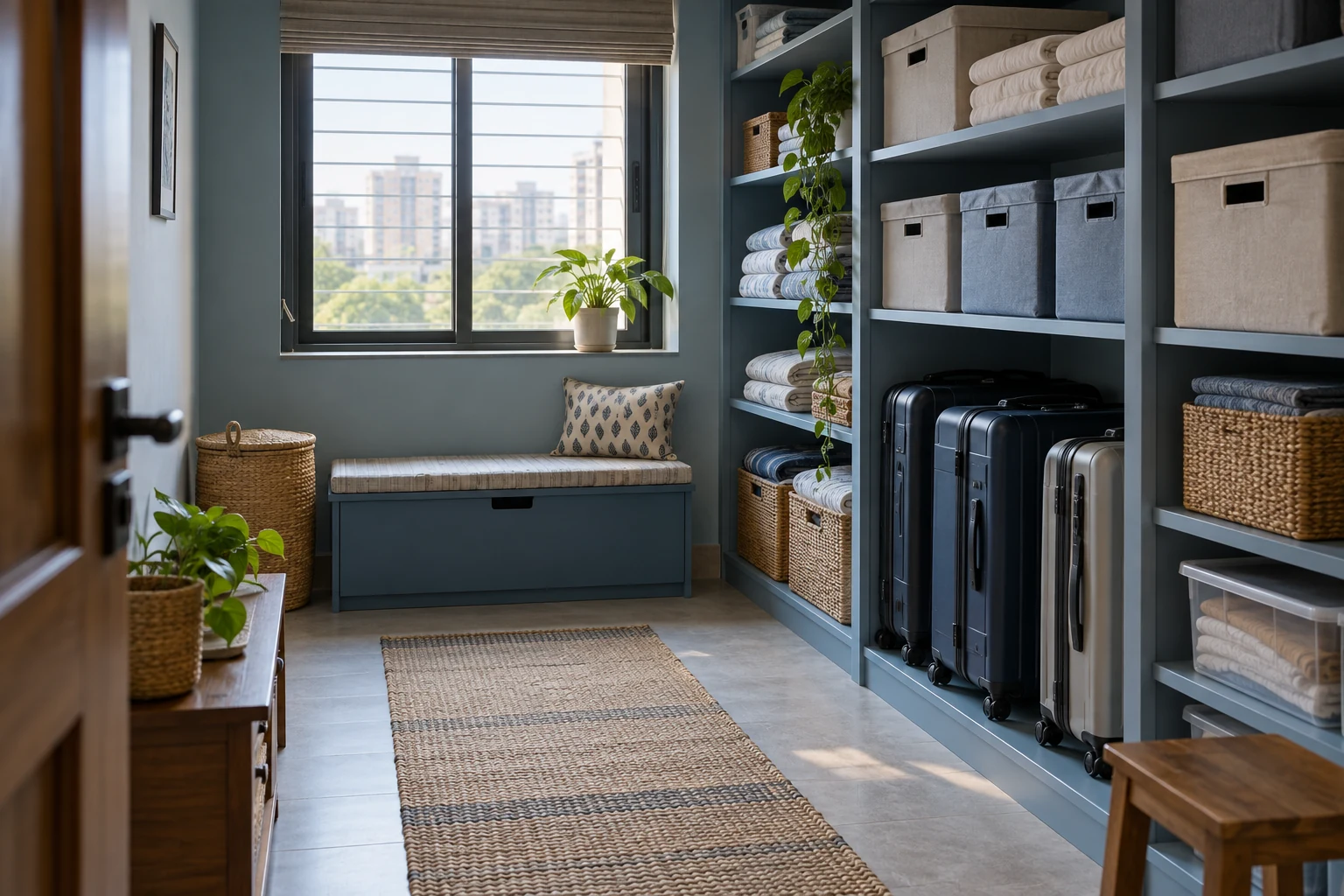
GODREJ SOUKYA ROAD · SEASONAL STORAGE
Godrej Soukya Road: Luggage and Seasonal Storage
Organise Godrej Soukya Road luggage and seasonal belongings through access frequency, retrieval routes and labelled storage.
12 September 2026 · 1,400 words · About 8 minutes
Ask about this topicGodrej Soukya Road seasonal storage planning starts with a simple distinction: some belongings need to be reached every week, while others only appear before a holiday or family occasion. Suitcases, extra bedding and seasonal decorations should have an intentional home without taking over the most convenient everyday cupboards. More storage is useful only when you can retrieve what it contains.
As you explore Godrej Row Houses Soukya Road, list the bulky items that would move with your household. This guide concerns organising personal belongings and selecting suitable storage. It does not confirm a dedicated storeroom or any particular built-in capacity within the project.
Inventory bulky items before designing cupboards
Group luggage, occasional textiles, celebration items and other infrequently used belongings. Record the actual dimensions of the largest pieces, including handles or protruding parts where relevant. A suitcase that appears compact when standing may need a different footprint when opened for packing. Consider both its stored state and its working state.
Ask when each item was last used and when it is likely to be needed again. Some possessions have a clear annual role, while others remain because nobody has revisited the decision to keep them. Discuss meaningful family items respectfully and give them a deliberate location rather than treating every unused object as disposable.
Avoid designing storage from the total number of boxes alone. A box may contain frequently needed travel accessories or decorations used once a year. The retrieval pattern determines where it belongs. Understanding the contents before ordering cabinets can prevent an attractive storage wall from becoming difficult to use.
Keep frequently used luggage accessible
If a household member travels often, their usual case should not be buried behind several seasonal containers. Choose a location that supports the actual departure routine and the person's ability to handle the item. Occasional larger luggage can have a different position, provided its retrieval remains practical.
Nesting suitcases may save space where the luggage design allows it, but consider what else is stored inside. If the most frequently used case holds several unrelated items, every trip begins with emptying and redistributing them. A compact arrangement is less useful if it creates repeated preparation work.
The Godrej Whitefield villas overview supports the broader shortlist. For storage planning, work with the actual room and furniture proposal rather than assuming that a general reference to generous space resolves the dimensions of bulky belongings.
Plan the retrieval route across levels
Think about where luggage is packed and how it reaches the exit. Storing a case on another level may be manageable for occasional travel, but less convenient for frequent departures. The best location depends on the household, not a rule that all storage should be concentrated in the least visible room.
Keep the path clear enough for the person handling the item and use appropriate help for difficult loads. Do not plan awkward lifting or reaching as a normal part of the system. A storage location that depends on improvised access is a reason to revise the arrangement, even if the item technically fits there.
The travel home-care guide connects luggage storage with departure and return. Giving the suitcase a clear place to pause during unpacking can keep a short trip from leaving bags in a circulation route for several days.
Label for recognition, not decoration
Use descriptions that the household understands. A label such as guest bedding is more useful than a decorative category that only its creator can interpret. If containers look identical, a clear label or simple inventory can prevent opening several boxes to find one item. The system should remain usable when someone else retrieves the contents.
Avoid excessive detail that becomes outdated after the first change. A broad category plus a short note for unusual contents is often enough. Keep the record with the storage arrangement so it can be updated when items move. A perfect inventory stored somewhere nobody checks will not improve retrieval.
When reviewing Soukya Road project search results, keep storage requirements in your own notes. Your inventory gives a designer concrete information that a broad marketing description cannot provide.
Match containers to contents and care
Choose containers appropriate to the belongings and follow relevant care guidance. Textiles, fragile decorations and travel equipment may have different needs. Do not assume one type of box is suitable for everything merely because it stacks neatly. Where an item has specific storage instructions, those instructions should guide the choice.
Think about the weight of a filled container, not just its empty size. Smaller manageable groups may be easier to retrieve than one very large box. Check the intended loading and installation requirements of shelving with the supplier, especially for a substantial storage proposal. Appearance does not establish capacity.
Leave enough access to recognise and remove the container without dismantling the entire arrangement. A tightly packed cupboard may maximise the number of objects stored while minimising the chance that anyone will use them. The purpose is a usable household store, not the highest possible packing density.
Give returns a defined routine
Seasonal storage works best when items return ready for their next use. Follow appropriate care instructions, check that components are together and note anything that needs attention. A decoration returned with missing parts or a travel accessory stored in the wrong case creates a problem at the next occasion.
Choose a practical time to complete the return rather than leaving an open box indefinitely. The household may prefer to put everything away immediately or use a short agreed window after an event. Either approach can work if the temporary location does not become a permanent obstacle.
The Soukya Road row houses reference can remain with your project research. The return routine belongs with the people who use the belongings, because their habits determine whether the storage stays organised after the first month.
Keep occasional storage from becoming forgotten storage
Belongings used infrequently can disappear from the household's memory even when they remain physically accessible. Choose a simple review point, such as preparing for the next trip or returning seasonal items. Confirm that the contents still match the label and that anything needing attention is dealt with before it is stored again.
If several people share a category, agree who updates it. One person may add a travel accessory while another removes it for a trip. Without a basic return habit, the container can look complete while an essential item is elsewhere. The system should support ordinary shared use without requiring a detailed inventory of every small object.
Keep empty capacity purposeful. A little room for a changing collection can be helpful, but an entirely unassigned cupboard may attract unrelated overflow. Give the space a broad role and review it before adding more storage furniture.
When a box has not been opened for years, discuss its contents rather than moving it automatically into the next convenient location. Some items remain worth keeping for personal reasons, while others no longer serve the household. Either decision is clearer after a review.
Finally, make the arrangement understandable to someone helping during a move or trip. Clear category names and sensible destinations reduce repeated questions and keep the system usable when its original organiser is not present. Good seasonal storage is a shared household resource, not a puzzle only one person can solve.
Keep your reviews simple to repeat, with clear decisions about what returns, what needs attention and which location will make the next retrieval easier.
Review storage when a season ends
An end-of-season review is a useful moment to notice what was actually used. You may find that certain containers should move closer to everyday storage while others can be consolidated. Avoid buying more cabinets automatically whenever a cupboard feels full. First ask whether the current allocation still reflects the household's needs.
Imagine a frequent traveller whose usual suitcase sits behind festival decorations. Moving that case to an easier location and grouping the occasional items separately removes a recurring inconvenience without increasing storage capacity. This is the central value of organising by access frequency: it improves use rather than merely appearance.
Take the bulky-item list to the Godrej Soukya Road project page when requesting relevant room information. Broader Godrej Soukya Road search references can support the shortlist. The most useful storage plan makes the next trip or family occasion easier, with belongings that can be found, handled and returned without reorganising the whole house.
More Godrej Soukya Road articles



EXPLORE THE PORTFOLIO
Projects by the same builder



Browse all Godrej project guides
Discuss your Godrej Soukya Road shortlist
Ask for the project details relevant to this guide.
Chat about Godrej Soukya Road: Luggage and Seasonal Storage