GODREJ VANANTARA · METRO LAST MILE
HOME → STATION → DESTINATION
Godrej Vanantara Metro Access: Last Mile Guide
Plan Godrej Vanantara metro access around station entrances, feeder travel and verified services rather than opening forecasts.
12 September 2026 · 1,400 words · About 8 minutes
Ask about this topic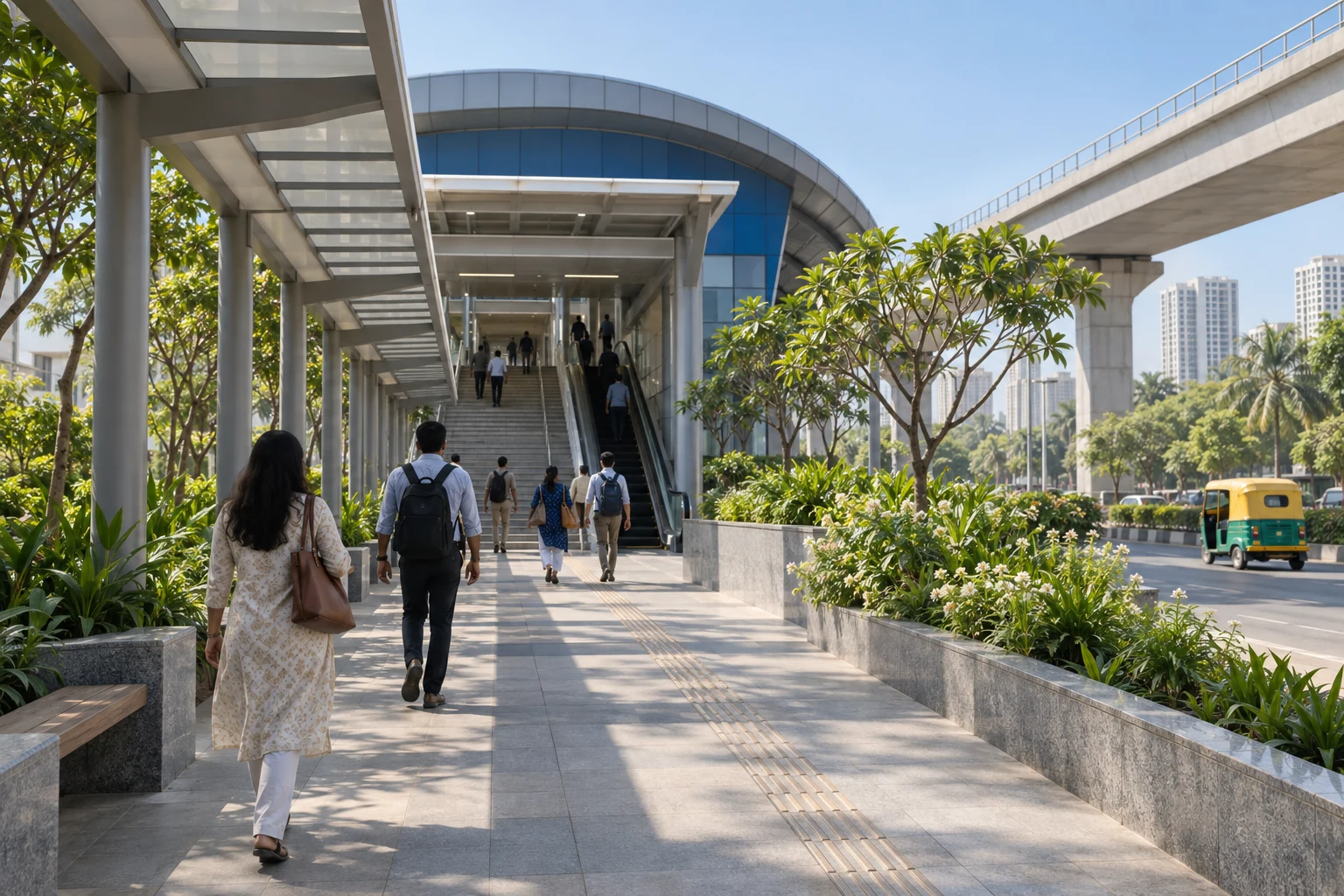
In this guide
- Verify the service before planning around it
- Use the station entrance rather than its centre pin
- Test the feeder journey in both directions
- Add the parts of the journey honestly
- Compare metro with your actual alternatives
- Consider comfort and accessibility
- Try a door to destination rehearsal
- Keep future improvements separate from today's decision
Godrej Vanantara metro access is a complete journey question: home to station, station to destination, and the return after work. A nearby corridor on a map does not establish a convenient daily connection. The station entrance, feeder options, operating section and your actual destination all need to fit together before metro access becomes a practical household benefit.
The developer's location page references Kalena Agrahara on the Pink Line. This guide does not confirm that the relevant passenger service is operating as of 12 September 2026. Check current BMRCL notices, then use the Godrej Vanantara location page to establish the residential end of your route.
Verify the service before planning around it
Consult BMRCL's passenger information for the current network, timetable and station information. Distinguish a planned corridor, a completed structure, a trial run and an announced passenger service. These are different stages. A construction update or expected inauguration date does not by itself establish that you can board a train today.
If a new section opens, confirm exactly which stations it serves. The opening of one stretch does not necessarily mean the entire line or every planned interchange is available. Build your route using the operational section relevant to your destination, with any remaining road journey shown explicitly.
Save the date of your check. Transport information can change between apartment research, booking and moving. A useful location decision should remain understandable under current conditions while treating future improvements as a separate possibility rather than a requirement that must arrive on schedule.
Use the station entrance rather than its centre pin
Stations can have entrances on different sides of a major road. Identify the entrance that is practical from the project and check how you would reach it. A straight line distance to the station building may omit crossings, barriers or a longer approach to the usable entry point.
Inspect the walking section where access is open and safe. Look at footpaths, crossing arrangements, lighting and shelter. Consider carrying a laptop bag in rain or travelling with someone who walks slowly. A short distance may still be awkward, while a slightly longer route with a continuous footpath may be more comfortable.
Do not assume a station shown in promotional material offers convenient parking or a particular pickup facility. Confirm the actual arrangements from current station information and observation. Your travel mode determines which details matter, so a driver's access check should not stand in for a pedestrian's experience.
Test the feeder journey in both directions
If you would use an auto, cab, bus or household dropoff to reach the station, test that specific option. Record waiting time as well as travel time. A feeder that is easy to arrange in the morning may be less predictable during the evening return or in heavy rain.
For a bus connection, verify the route, stop and operating schedule with the current operator information. For a private shuttle, confirm who operates it and whether access is actually available to you. A proposed or informally discussed feeder should remain an unconfirmed option until its service conditions are clear.
Think about where you wait at the station and at the project. A safe, practical pickup point matters when travelling late or with children. If the preferred option is unavailable, identify a realistic alternative before treating the metro journey as your only dependable way home.
Add the parts of the journey honestly
A complete estimate includes getting from your apartment to the project exit, feeder waiting and travel, station entry, train waiting, the train journey, any interchange and the final walk or ride. Navigation summaries may combine or omit some of these parts. Write them separately so you can see where uncertainty sits.
For illustration, imagine ten minutes reaching and entering a station, five minutes waiting, twenty minutes on the train and fifteen minutes after exiting. The complete journey is fifty minutes, even though the train portion is only twenty. These are invented values, not Vanantara or BMRCL timetable figures.
Repeat the calculation for the return. A different exit, reduced feeder availability or a late finish can change the result. The useful measure is the experience across an ordinary week, not the fastest possible connection when every transfer happens immediately.
Compare metro with your actual alternatives
Use the same start and end points when comparing metro, driving and employer transport. Include parking, walking and waiting consistently. Otherwise, you may compare a complete public transport journey with only the driving time shown by an app, which gives an uneven picture.
Cost also needs the complete journey. Add current fares and any feeder or parking payments that apply to your chosen route. Obtain current amounts from the relevant operators instead of copying an old rate table. A lower train fare does not necessarily mean the lowest total daily travel cost once the first and last legs are included.
The Electronic City commute guide provides a road based comparison method. Use it alongside the metro assessment when that is your work destination. The best option may differ by office day, weather or working hours rather than being the same every morning.
Consider comfort and accessibility
Travel time is only one part of usability. Think about crowding, standing, luggage and the number of transfers your household finds comfortable. Someone travelling occasionally may accept an arrangement that feels tiring when repeated every weekday. Discuss these preferences with the people who will use the route most.
Where accessibility matters, check the actual entrance facilities and the complete path through the station with BMRCL. Do not assume that the presence of an accessible feature somewhere in the station guarantees an equally convenient route from every approach. Temporary maintenance conditions can also affect the journey on a particular day.
Include the apartment's internal access in this discussion. The route from your door to the pickup point can involve lifts, corridors and internal roads. A station connection becomes more realistic when you assess it from the actual home rather than starting the clock at the project boundary.
Try a door to destination rehearsal
Once the relevant passenger service is officially operating, rehearse the entire journey on a day similar to your normal schedule. Start at the intended residential pickup point, use the feeder you expect to rely on and continue to the final destination. Record where you wait, transfer or walk, not only the time spent inside the train.
If the service is not yet operating, you can still inspect permitted public approaches and research current alternatives. Label the train portion untested. Do not fill it with an optimistic estimated time and present the completed route as verified. The missing part is important information in its own right.
For an illustrative comparison, one household may value a predictable train segment even when the total journey is slightly longer. Another may find two feeder rides inconvenient with a child or heavy equipment. These are reasonable differences in preference. A route assessment should capture comfort and reliability alongside minutes and fares.
After the rehearsal, identify the weakest link. It may be evening pickup, an awkward crossing or an interchange that is not yet available. Ask whether a practical alternative solves that particular problem. This focused approach is more useful than deciding that metro access is either excellent or irrelevant based only on the presence of a station name in a location brochure.
Check the exact final workplace destination as carefully as the residential end. A station near an office district may still leave a substantial walk to your building entrance. Weather, road crossings and workplace access rules can affect that last section. If your job location might change, avoid treating one convenient route as proof of convenience to every employment area. Keep the assessment tied to the destinations you know, and revisit it when a real change occurs rather than trying to predict every future journey.
Keep future improvements separate from today's decision
You can recognise the potential value of a developing transport corridor without assigning it a guaranteed opening date, travel time or price benefit. Maintain two short notes: the route usable under verified current conditions and the route you would reassess after a specific service announcement. This keeps expectations clear.
Ask through the Godrej Vanantara project enquiry for the correct site entry and relevant location material, then verify passenger operations independently. A credible metro assessment follows the entire journey and remains useful even when infrastructure schedules change.
More Godrej Vanantara articles

EXPLORE THE PORTFOLIO
Projects by the same builder


Browse all Godrej project guides
Discuss your Godrej Vanantara shortlist
Ask for the project details relevant to this guide.
Chat about Godrej Vanantara Metro Access: Last Mile Guide